
 A unit of the Ministry of Culture and Communications and successor to the “High Committee of the French Language” which was established on this day in 1973 by the government of Charles de Gaulle to find authentically French substitutes for some three hundred and fifty creeping Anglicisms, la Délégation générale à la langue française et aux langues de France, essential is a continuation of that original mission and charge, though now importantly acknowledging a plurality of languages of the country—see also here and here. Five decades ago, changes included dropping flashback for retrospectif, palmarès for charts or hit parade and navire citene for tanker.
Wednesday, 18 January 2023
dglflf (10. 477)
Tuesday, 17 January 2023
down-scrolling (10. 476)
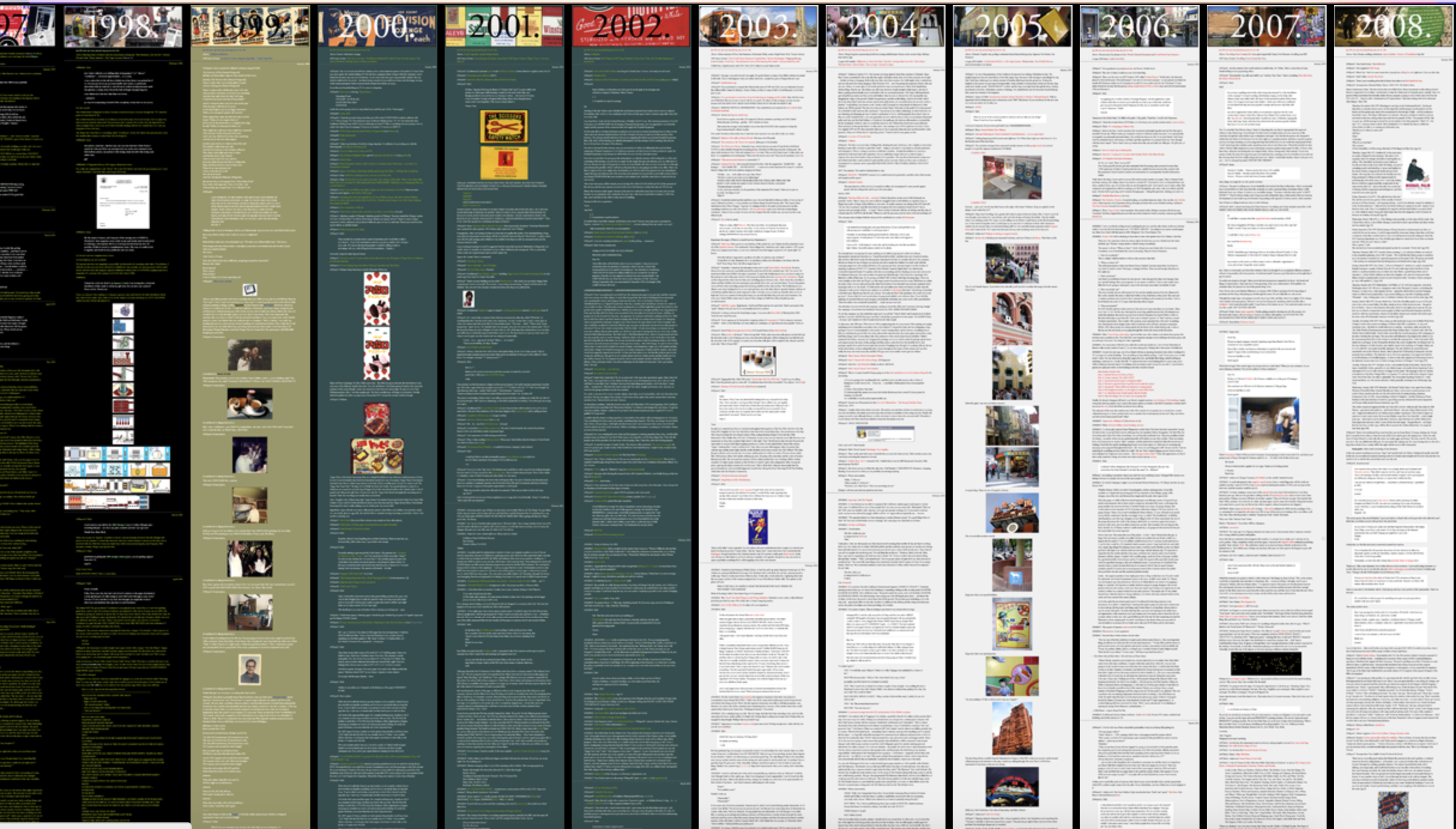
Ur-blogger and fellow internet peripatetic Cardhouse (EstD 1994) shared their experience making a strips version of their site that captures all the years of posting over the years as a rolling-snapshot—which reminded me of these tributaries and outflows of history, some ways of displaying, including one custom, handcrafted approach that reflects the website’s own navigation buttons. If you’ve a long blog, give one of these methods a try and share what you’ve found to be best.
7x7 (10. 475)
inflection point: one young person’s crusade to salvage writing, journalism before ChatGPT changes it forever
 beasts of burden: the giant donkeys of Ancient Rome—see also
birth-rate: China registers its first population decline in six decades
ren faire: author Eleanor Janega’s Once and Future Sex
level 100 schlamm zauberer: police attempt to clear remaining protester demonstrating against the demolition of the hamlet Lützerath for surface mining of coal—see previously
☠️: a safety warning from the Electric Company (1973)
midway in the midjourney of our lives: what AI does well and why AI is not intelligent
Monday, 16 January 2023
9x9 (10. 474)
j.t. iv: the compilation “Cosmic Lightning” of a tragically forgotten outsider rock artist
tees valley: a dialect map of England from the University of Leeds
 bundesministerin der verteidigung: German defence secretary steps down
courtlife: Queen Victoria’s illustrated journals—see also—via Messy Nessy Chic
mlk: Stevie Wonder’s campaign to make Martin Luther King Jr’s birthday a national holiday
wef: global leaders gather in Davos
buona sera: actor, photojournalist and sex symbol Gina Lollobrigida passes away, aged 95
scare-fox: accidentally Art Brût predator-deterrent
atomic rooster: a classic from the spin-off band of Crazy World of Arthur Brown
the night of january sixteenth (10. 473)
 In a rather satisfying coincidence, this day in 1983 marks the the expiration of the monopoly for the manufacture of safety matches (Zündwarenmonopol) in West Germany when the rights were acquired by Swedish swindler, Ponzi scheme architect and racketeer Ivar Kreuger—the Match King who’d fit in perfectly with contemporary grifters and fraudsters—in 1930 with a loan of five hundred million Reichsmark to the Weimar Republic, whose bonds extended through World War II and finally lapsed—and the titular stage play by Ayn Rand (previously), inspired by the death of Kreuger († 12 March 1932—usually performed as Woman on Trial.
  The lover of industrialist Bjorn Faulkner (Kreuger’s analogue, whom Rand became obsessed with though was quite a questionable pillar to uphold) is accused of his murder and the author’s intent to dramatise the conflict between conformity and individualism leaves the verdict unresolved and invites the audience to decide. The courtroom setting is artistic license as most likely Kreuger committed suicide facing the prospect of bankruptcy once accounting manipulations were revealed, paying investors dividends from their own money. One year after its premier in Los Angeles, the production team took it to Broadway in 1935 and saw a revival in 1973 under the title “Penthouse Legend.” Meanwhile it was adapted into a film in 1941—which was not a commercial or critical success—and a 1989 Bollywood version called Gawaahi (Testimony), which might be worth seeing.
socks cousteau (10. 472)
 No one can resist a fun novelty sock but it seems that neural networks are not yet exactly pushing the frontier on novel patterns as our AI Wrangler (previously) demonstrates, since as a rule it’s taught to rehash established answers, naming predictable and extant subjects but was impressively keen on alliterative gatherings of animals, like: Antelope Anarchy, Gazelle Groove or Elk Extravaganza with the various ungulates in party hats. Much more at the links above.
lemminkäinen, very pretty (10. 471)
 First subjected to the MST3K treatment on this day in 1993 (broadcast edition below, preceded by the short “Here Comes the Circus”), the 1959 cinematic anthology of Finnish folk tales and loosely based of the national epic sage Kalevala, the co-Suomi-Soviet production by Aleksandr Ptushko and Risto Orko was also marketed under the title of the main MacGuffin, the mystical Sampo (see also)—a magical mill that will grant limitless prosperity to whomever possesses it. The only person in the realm able to craft a Sampo is the smith Ilmarien, who cannot make it until his sister Annikki falls in love, which she eventually does, enamoured with our pure-of-heart and hard-working protagonist. A evil witch called Louhi, ruler of the dark and dismal Pohjola is also desirous of a Sampo and ransoms Annikki to her land, kidnapping her by means of an enchanted cloak. Lemminkäinen must perform a series of seemingly impossible tasks to win her back, with the last challenge going to her brother, Ilmarien, to fashion a Sampo. ”Look, it‘s Thomas Edison and his Electric Child!“
Sunday, 15 January 2023
spider web castle (10. 470)
Considered among the finest adaptations of the Scottish play with production and development deferred f or six years after learning that Orson Welles directed his own Macbeth in 1948, Akira Kurosawa’s (previously) transposition of the plot of Shakespeare’s masterwork to feudal Japan (蜘蛛巣城, Kumononsu-jō—literally the above title but released in English-speaking markets as Throne of Blood) premiered in Tokyo on this day in 1957. Under contract to produce three samurai movies (jidaigeki—period, costume dramas) for Toho studios, Spider Web Castle was originally slated to go to director Ishirō Honda, best known for his 1954 kaiju classic Godzilla but Kurosawa ended up making the trio of films. His 1960 The Bad Sleep Well was informed by Hamlet—though not a direct correspondence—and Kurosawa’s final work Ran, which is based off of King Lear. Throne of Blood in turn influenced Roman Polanski’s adaptation of Macbeth and the death of Taketoki Wasizu (the Lady Macbeth analogue) inspired the death of the mother of the titular Carrie in the 1976 horror classic.


