
 While perhaps best known for his influential Münchener Olympic pictograms and creating the modern corporate identity for Lufthansa, Ulmer resistance fighter of the White Rose movement, graphic designer and typographer Otto “Otl” Aicher (*1922 – †1991), was also a prolific poster designer, glad recipient of all sorts of commissions—though we think some of these are works of his students. After the war, Aicher married the resistance movement’s leaders’ elder sister, Inge Scholl, and together with Swiss architect Max Bill founded the Ulm School of Design (Hochschule für Gestaltung Ulm, HFG) as a philosophical spin-off of Bauhaus in 1953. Much more to explore at the links above.
Sunday, 16 June 2019
erscheinungsbild
a good year for the poppies
 I know that superblooms are a highly specific coming together of exceptional growing conditions that lets Nature revel in all her immodesty pertaining to wildflowers growing in arid places but after the droughts of last summer and the dry spring, it was very nice to see the pastures and the verges along the road and between fields bursting with colour.
downstream effects
 Never mind the fact that you might be ingesting multiple tiny spiders per night—or conversely that if the spiders of the world teamed up, they could consume all the humans on the face of the Earth (or cocaine prawns or antidepressants in the groundwater), the World Wildlife Foundation launches a new campaign to illustrate the awful non-food pyramid that we’ve created. Via the Drum, we learn that on average a person consumes one hundred thousand micro-plastic particles annually, meaning about five grams (a lot of different factors come into play and you can get a more personalised estimate of your dietary intake here), a credit card’s worth of the stuff each week.
Saturday, 15 June 2019
arterial road
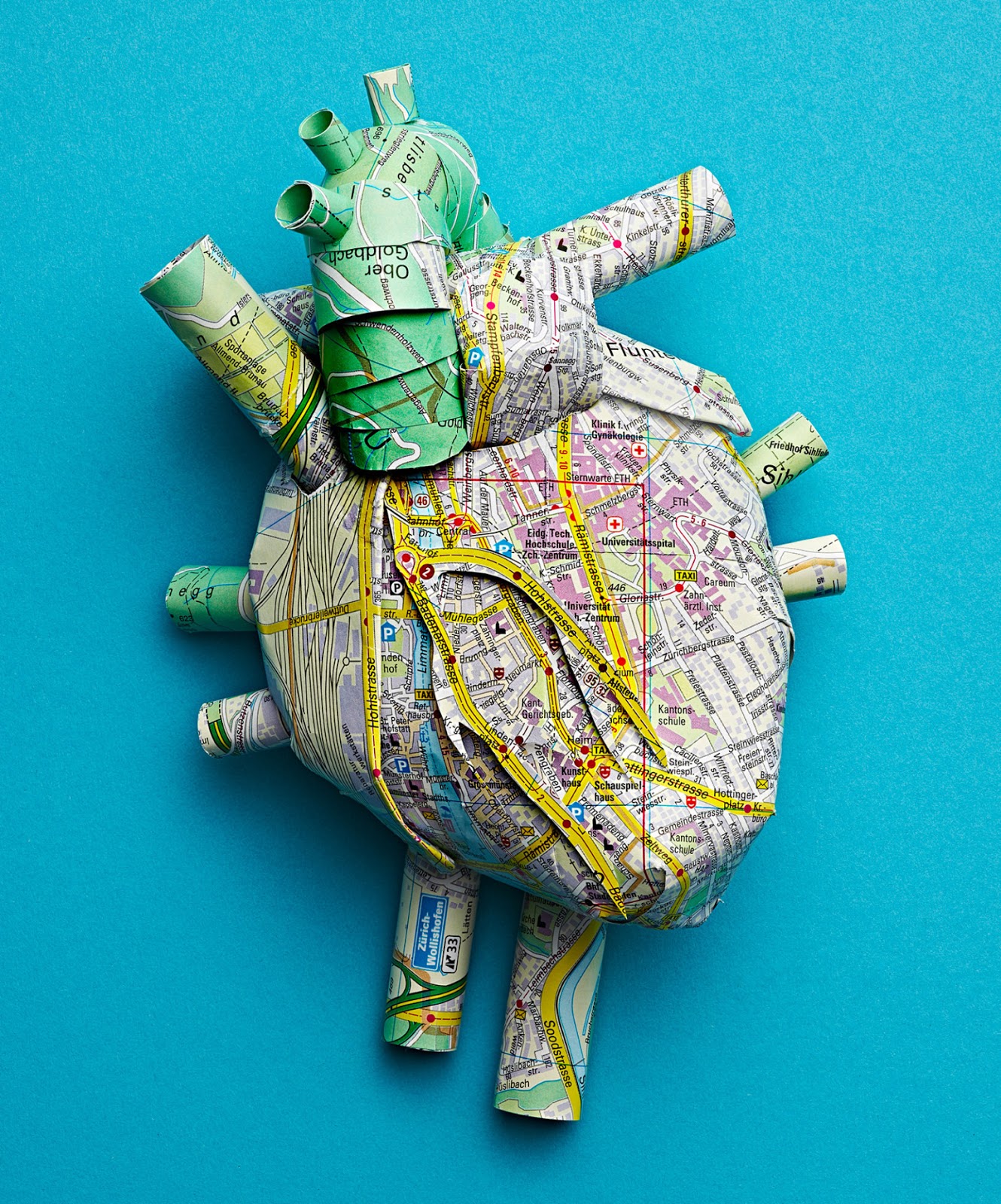 Fusing anatomical studies with paper-sculpting, Berlin-based artist Katrin Rodegast has created several organs fashioned out of maps with roadways and watercourses meant to highlight the similarities of civil engineering (Ein – und Ausfallstraße) with the network of capillaries and arteries in our bodies as a series of commissions for Eidgenössische Technische Hochschule (ETH) Zürich. The Swiss polytechnic’s 2017 chief research thrust was a big collaboration among twenty institutions to make a viable artificial heart—for which Rodegast’s cartographic anatomy was an important part of the outreach programme and partnership cohesion.
powertrain
Among the items and lots going under the hammer this summer, auction-watcher Messy Nessy Chic reports is this pristine 1964 Peel Trident, a British microcar and a product of Manx engineering, the estimated forty-five to fifty-five models made mostly going to the mainland.
 Originally priced at £190 and with fuel efficiencies of just under three litres per one hundred kilometres and touted as nearly cheaper than walking, the smallest car in the world was perhaps a little ahead of its time and interest waned among the driving and dashing public (the car had a detachable shopping basket and was primarily meant for quick city errands). Manufacturing operations resumed in 2011 in Nottingham, creating custom electric and petrol models for individual clients. Learn more and inspect other lots and properties up for auction at the link above.


