On this day in 1576, having weighed anchor around a month earlier with Queen Elizabeth’s financial backing, explorer and privateer Martin Frobisher, whilst on the first of three voyages to the New World, in search of the Northwest Passage to Cathay and the East Indies, spotted the coast of Greenland, although assuming it was the non-existent phantom island Frisland (also called Fixland or Portlandia) that appeared appeared on virtually all maps of the North Atlantic for a century, dissuaded from claiming it for the Crown as chartered territory. Landing in the eponymous bay on Baffin Island in the present day Qikiqtaaluk region of Nunavut (it was that then too), Canada, Frobisher failed to find a new route but was encouraged and petitioned for follow-on excursions, having brought back an interesting rock specimen and influenced during his service in Africa’s Gold Coast, having managed to seize a lode of precious specie that the Portuguese had procured.
Although metallurgical experts told Frobisher that his souvenir was hornblende, not classed as a specific composition, like Fools’ Gold, but a category of otherwise worthless rubble that appears like ore-bearing substrate. Dissatisfied with this assessment from the assayers, Frobisher brought the sample to a Venetian alchemist living in London, one Giovannia Battista Agnello, whom had previously convinced Elizabeth to debase small coinage with a teston of lead plated with copper (see previously), whom, arguing that one must know how to flatter nature—“Bisogna sapere adulare la natura”—claimed there was gold in it. For his second voyage, the queen lent Frobisher additional ships with a compliment of Cornish miners, which was more devoted to collecting rather than discovery. The expedition returned to Milford Haven in September of 1577, carrying two-hundred short tonnes of valueless rock. Despite the disappointment, Elizabeth retained a strong faith in the potential of the new colonies and authorised a third trip to this Unknown Shore, which she named herself. The territory of Nunavut’s was also named after Frobisher from devolution in 1942 until 1987 when it was renamed แแแแแฆ (Iqaluit, place of many fish).
Saturday, 11 July 2026
meta incognita (13. 612)
Wednesday, 27 May 2026
tafone (13. 465)
Though in my head I had been referring to such geologic weathering as Roadrunner and Coyote rocks, we learned that tafoni, from the Corsican pietra tafunata meaning perforated stones is bc the proper term for this sort of erosion and chemical reaction—with examples to be found worldwide in granite, limestone and sandstone and is especially prevalent on Sardinia and Corsica.
synchronoptica
one year ago: what a decibel registers (with synchronopticรฆ)
thirteen years ago: bad operating systems, cheese banks plus drone-patrols for vandals
fourteen years ago: Eurovision boycotts plus Centralia, Pennsylvania
seventeen years ago: jingoistic language
Monday, 30 March 2026
9x9 (13. 308)
ruina montium: an striking landscape in Spain created by the ancient Romans fracking for gold—via Miss Cellania
13 ๏ฝ 7 = 28: Abbot and Costello try to meet their sales quota—via MetaFilter
i’m your hell, i’m your dream—i’m nothing in between: a linguistic and semantic history of the term bitch
anatoly kolodkin: US waives sanctions to allow Russian tanker to deliver crude oil to Cuba

coalition of the willing: recalling the legacy Icelandic PM Davรญรฐ Oddsson of committing the nation to the unjustified invasion of Iraq in 2003, juxtaposed with contemporary Spain
cocktail nation: Spy Vibe’s regular segment on swank vintage soundtracks
lip-filler accent: influencers inform the way we speak—via Nag on the Lake, see also
gigo: AI is an accelerant for academic fraud, selling papers and citations to pad one’s portfolio
unoosa: a profile of the director of the UN Office for Outer Space Affairs who alerts the world of impending asteroid impacts
Monday, 22 December 2025
9x9 (13. 024)
participation, in this context, is a kind of alignment: the Vanity Fair photo shoot of Trump’s cabinet
escape velocity: a super-massive runaway black hole has been ejected from its home galaxy and is careening through space—via Kottke
that thoth over there: a guide to the messy divine family of Egyptian mythology
beyond the last-minute gift guide: the year of Tedium wrapped
no-one comes to casablanca for the waters—you were misinformed: every drink in the 1942 classic (see previously, oddly no gin)—via MetaFilter
capital allocation: on the social uselessness of finance, creating winners and losers
homecoming: a preview of Christopher Nolan’s adaptation of Homer’s Odyssey—see also
intraterrestrials: subsurface microbes have geological lifespans
unreliable narrator: Epstein and company as Nabokov’s Humbert Humbert—see previously
Wednesday, 29 October 2025
951 gaspra (12. 834)
Discovered in 1916 by astronomer Grigori Nikolaevich Neujmin, one in a catalogue to his credit of
hundreds of minor planets and comets, and named for the Crimean spa town near Yalta that was favoured by Neujmin’s contemporaries like Tolstoy and Gorky, the asteroid was visited by the Galileo space probe on a close fly-by on this day in 1991 en route for its mission to explore the Jovian system (see also), the first time such an object was encountered at close range and studied, the rendezvous a technically challenging one since only its approximate location was known by projecting its orbital path. The irregular shaped silicate-rich asteroid is approximately the size of Guam and has the pictured astronomical symbol, a simplification of the resort town’s coat of arms.
synchronoptica
one year ago: a mascot for the Vatican (with synchronopticรฆ) plus IKEA acknowledges forced labour in East Germany
thirteen years ago: media ownership under threat
Saturday, 13 September 2025
11x11 (12. 724)
out damn spot: the attempted erasure of a Banksy mural shows one cannot scrub away complicity in genocide
free return trajectory: acting NASA administrator faces the space press on getting intriguing rock samples from Mars to Earth for further study
canonically accurate: Spirit Halloween corrects the spelling on their Betelgeuse prop sign—see previously here and here
jawsome: the promotional hyping of some thing as “awe dropping” connotes rather the opposite for me
maternity ward: track new website launches by category in real-time—a lot of click-bait landing sites being cloned badly by AI but some genuine births as well—via Web Curios
goodbye computer: a sad little send off from April Clucks about a machine she adored until they became unlovable
me'te.o.ra: ambient music generated by local weather conditions—via Clive Thompson’s Linkfest, which also features a defence of the em-dash
midway: the aesthetics of arcade game marquees
cornutam: Moses’ depiction in art as having horns is a mistranslation from the Vulgate perpetuated by centuries of tradition
an asymmetrical curiosity: physicists construct a tangible demonstration of time-crystals
what sophistry is this: at the advice of legal counsel, Jezebel pulls an article from early in the week about hiring some Etsy witches to curse a right wing influencers and conservative activist—see previously, see also
Friday, 12 September 2025
motor city agate (12. 721)
Recalling a recent look at the much accelerated process of synthetic geology, we quite enjoyed this introduction to this gem of industrial inefficiency (which illustrates how the push for optimisation comes at a cost, though waste and pollution is to be avoid, the drag and misalignment that meant non-targeted ads for everyone was what enabled journalism and broadcast entertainment in the first place—
which are no longer free and still serve commercials and designed obsolescence and the inability to repair and upgrade over replacing) that by dent of its relative scarcity and specific epoch has become one of the most appealing media for jewellery makers. Technically a cabochon, from the French to distinguish a stone that is not cut and faceted but rather shaped and polished, the agate was the byproduct of applying enamel coats to automobiles by hand, with overspray accumulating in paint bays and the layers of slag, ages within epochs, particularly from the late 1960s and early 1970s, when “high impact” colours were in fashion, have become highly sought after. Changes in bodywork by the 1980s saw the adoption of electrostatic painting, basically magnetising the enamel to the chassis, meant the end of this era.
Friday, 1 August 2025
anthropoclastic rock cycle (12. 624)
A couplet of recent postings about synthetic geology caught our eye—first about the accelerated process of material formation reduced to decades instead of the usual millions of years in the cases of slag heap debris fusing into sediment along the English coast and colourful industrial waste prepared with concrete to solidify and stabilise it—allowing for easier disposal without the normal caretaking required for liquid toxic waste and instead leech it out over aeons. We wonder what future archeologists will make of this anthro-littoral strata.
Tuesday, 11 March 2025
inatsisartut (12. 296)
Though a referendum for independence is not explicitly on the ballot, forty-thousand of the island territory’s population of fifth-six-thousand residents have cast their vote in what could be consequential election of the autonomous region with geopolitical overtones that extend far beyond local politics. Characterised as a “fateful choice” for Greenlanders by the Prime Minister Mรบte Inequnaaluk Bourup Egede (incidentally a descendant of eighteenth century missionary Hans Poulsen Egede who founded the
capital as Godthรฅb, now known as Nuuk, documented one of the earliest encounters with a sea-serpent and had challenges translating the Lord’s Prayer as the populace had no concept of bread and first tried to convey “Give us this day our daily seal”) of the democratic socialist Inuit Ataqatigiit pro-independence party, previously lobbied successfully to leave the EU over fishing rights, while recognising how the strategically located landmass is a point of contention for polarised powers seeking a foothold in the Arctic and mid-Atlantic. Results, once the tally is complete—an arduous task on the world’s largest island (granted home rule since 1979 with the above titular unicameral parliament—“those who make the law”) to collect ballots from isolated communities and general not subject to immediate speculation—will indicate whether Greenland wants to rehabilitate relations with Denmark or move towards integration with the United States with overtures to “buy” (or annex) it outright for its geographical vantage point and mineral wealth. Sentiment suggests that Kalaallit would prefer to be prefer and allowed self-determination and reject becoming another colony, especially given US imperial ambitions and its disrespectful and untrustworthy treatment of supposed allies and partners.
Saturday, 17 February 2024
selenology (11. 356)
From the Amusing Planet’s archives, we are directed towards the 1874 work of engineer and hobbyist
astronomer and photographer James Nasmyth of Edinburgh through his speculate volume on lunar geology called The Moon: Considered as a Planet, a World, and a Satellite, a compendium of research and observations, supplemented by a number of highly detailed photographic plates produced during a time when it was not technically possible to take such striking images directly through a telescope. Instead, Nasmyth improvised by making sketches from what he could see through his self-made observatory and transforming them into plaster relief scale models and photographing those under electric illumination to highlight the shadows and contours of his topographic globes. This work carried out after retirement from heavy industry, having invented the hydraulic press and the steam hammer and other machine tools, an impact crater (he had incorrectly theorised volcanic origins, though later research confirms lava flows) on the Moon is named in honour of Nasmyth himself, just to the west of the pictured Wargentin, for his lifetime of accomplishments.
catagories: ๐, ๐ด๓ ง๓ ข๓ ณ๓ ฃ๓ ด๓ ฟ, ๐ท, ๐ญ, ๐ชจ
Saturday, 3 September 2022
ausflug thรผringenersee (10. 107)
H and took a summer’s end quick excursion to the dammed Saale river valley to tour the landscape that developed around the reservoirs (Stauseen) and how the natural intersects the artificial.
First we stopped to take a guided tour of the Saalfeld Fairy Grottos (die Feengrotten), a set of caverns in a former mine for alum shale (see previously) remarkable for their colourful mineral veins, called speleothems, owing to the porous soil.
Commercial operations halted in 1850 (the use of potassium aluminate as a preservative was antiquated) and was opened to tourist as early as 1914 due to the reputedly curative properties of the ambient radiation present, after the discovery of the third chamber, the Mรคrchendom—the Fairy Tale Kingdom and the Grail Castle after various interpretations of the sedimentary creations.
Seeing this tableau inspired Siegfried Wagner to pattern the set design for his father’s opera Tannhรคuser for the Bayreuth Festspiele in the 1920s.
catagories: ⚒, ๐ชจ, libraries and museums, Thรผringen
Saturday, 20 August 2022
erlebnis bergwerk (10. 073)
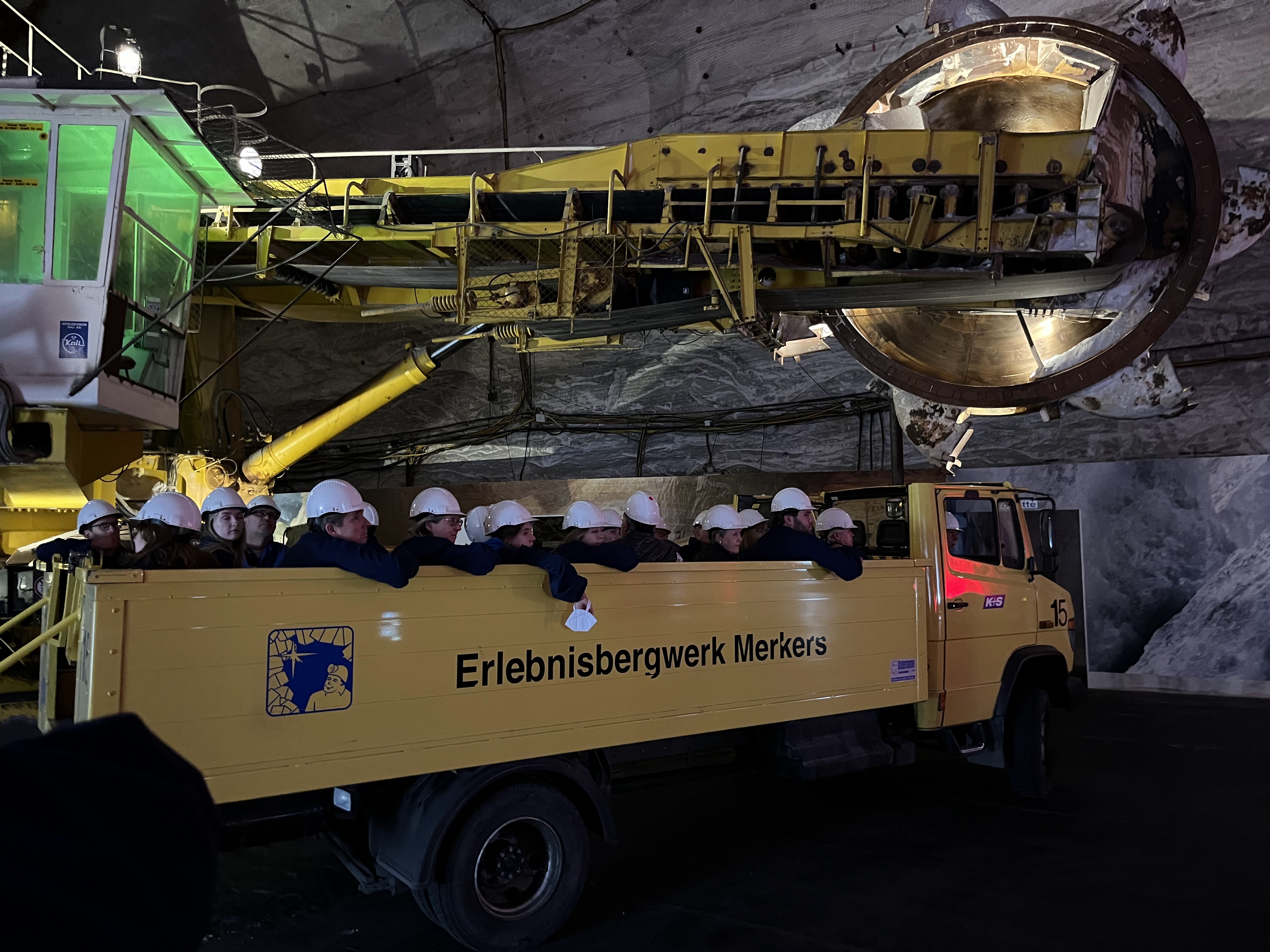
Decommissioned since 1993 but revitalised since as a living museum and working mine and venue, I had a chance to visit with H’s father the salt and potash (Kalisalz, used as an important agricultural fertiliser) extraction operation near the village of Merkers on the Werra river not far from Bad Salzungen.
Aside from the long history of mining and a comprehensive lesson on the enterprise and geology that bores under the Rhรถn mountains, the location is also the hiding spot for hundreds of tonnes of gold, silver and paper currency (amounting to around eighty percent of the holdings of the Reichsbank at the end of the war) and many priceless works of art looted by the Nazis, discovered per chance by the advancing United States army (tipped off by slave labour transporting treasures to the mine) who then worked quickly to clear it out of Soviet occupied territory before the borders were demarcated.After being lowered in safety gear—like actual miners beginning their shift—in a hoisting cage that descended into the dark, and driven in flatbed transports from five to eight hundred metres below the surface through a network of tunnels that covers an area the size of Munich.
Though the vehicles were only taking the dips, curves and ascents at under twenty kilometres an hour, the darkness, wind and narrowness of the shaft made it seem much faster, like a roller coaster ride stretched out for some two hours, with intermissions, lastly in the above Goldraum, a pair of excavated former bunkers that now serve as a machine exhibit, theatre and a concert hall with uncommonly good acoustics and unique crystal grotto with accompanying bar for refreshments—the deepest in the world.
catagories: ⚒, ๐ฉ๐ช, ๐ข, ๐จ, ๐ชจ, Hessen, libraries and museums, Rhรถn, Thรผringen
Thursday, 30 June 2022
๊ฆ
Co-founded by Stephen Hawking, Queen guitarist and astrophysicist Brian May and other former astronauts and technologists with the sanction of the United Nations, International Asteroid Day is an
annual observance meant to promote awareness about the minor planets of the inner Solar System and the threats that these near-Earth objects can pose for cataclysm and ways to mitigate the vulnerability through close monitoring. 30 June was chosen as the date as it marks the anniversary of the 1908 Tunguska Event in the Eastern Siberia Taiga, an estimated twelve megaton explosion that flattened two thousand square kilometers of forest caused by the air burst of a meteoroid, devastating for local wildlife but spared greater catastrophe by dint of the region being sparsely populated by humans.
Sunday, 6 March 2022
8x8
wayfinder: Polynesian palm frond and seashell navigational charts
zoned for resimercial: reaction offices and the future of the workplace
such freedom: a convoy of truckers whose grievance is less clear picks up some hitchhikers along the way in the form of a la carte conspiracy theories
fashion forward: RIP to Elsa Klench (*1930) host of the long running Style segment on CNN
don’t know much about geology: James Sowerby’s 1884 illustrated study of catastrophic British mineralogy
the neutra house: the hilltop compound that belongs to Red Hot Chilli Pepper Flea has strong evil villain lair energy—and is on the market—via Nag on the Lake’s Sunday Links
glonass: mapping tools and satellite imagery as a prelude to the information war over Ukraine
Friday, 4 March 2022
for what it’s worth
Via Kottke we are directed to a highly compelling project from Dillon Marsh that visualises mines in South Africa with a scale model representing the specie, minerals or gemstones extracted from it—like in this composite photograph of the Jubilee Mine in the Namakwa District and the sixty-five-hundred tonnes of copper ore dug from the Earth. Gains seem particularly marginal, inefficient and pathetic in comparison to all the hardships in cost of human toil and exploitation and environmental damage. More at the links above.
Friday, 16 July 2021
sveafallen
Friday, 28 May 2021
seashore—never more
Via Strange Company’s Weekend Link Dump, we learn that during his life time, Edgar Allen Poe’s most popular and best-selling work was the field guide “The Conchologist’s First Book.”
In the 1830s, geology, due to the rising interest in coal as a fuel source, and its sister-science of conchology (see previously) were the hottest commodities as combined, it allowed one to expound on Earth’s history through studying successive strata, and Poe’s slim and portable contribution to the discipline was well-received and had the poetic and evocative subtitle: A System of Tesataceous Malacology—that is, the study of small, soft-bodied creatures by exhuming their hardened ruins. Though perhaps not the most expressive vehicle, some of the author’s flair and license does manage nonetheless to shine through. Much more to explore at the links above.
Sunday, 28 June 2020
nakhlite type
The classification of Martian meteorite (see also) that was the first of its kind to suggest the presence of water and then for a tantalisingly brief time nearly a century later as technology and analysis methods improved microbial life, named for the Egyptian village of El Nakhla El Bahariya were it fell, broken up by the heat of entry into about forty samples raining down, on this day in 1911.
They are ejecta of volcanic rock from the plains Elysium Mons that was able to escape the planet’s gravity through a violent asteroid impact, wandering through space for ten million years before being captured by Earth, occasionally impacting over the past ten thousand years. Though likely apocryphal since there were no remains recovered and no other corroborating witnesses, astronomers still repeat the legend and it’s become a mascot in the field of meteor studies, a local farmer recounts how a fragment landed directly on his canine helper, vaporising the animal without a trace, the so-called Nakhla dog. In 1999, a sample previously unexposed to earthly elements was cleaved off and studied using a powerful scanning electron microscope revealing a matrix of pores very similar—though not conclusively so—to the traces that bacteria would leave in rocky substrate on Earth, leading many researchers to conclude that the Red Planet at least at one point harboured the niche environment that could support life.
Tuesday, 28 May 2019
burg stolpen or under the rainbow
H and I decided we would let our vacation be at the mercy of the weather and it started raining without pause from midnight Monday onward, so after decamping, soggy, we started on our way back, making a detour to see Burg Stolpen, the town and a thirteenth century castle at the foot of a mountain of the same name and hewn out of basalt columns.
The mineral was first classified and described at this particularly rich quarry by local natural philosopher Georgius Agricola in a 1556 treatise.
The pictures are of the residence and prison of lady-in-waiting and mistress of Augustus II the Strong (der Starke) Anna Constantian von Brockdorff—eventually styled Countess of Cosel (Reichsgräfin von Cosel, *1680 - †1765)—who eventually earned the displeasure of her lover, imperial elector and king of Poland by her advocacy for the rights of Polish subjects.
Anna was banished from court and placed under house arrest in the tower for just under fifty years.
Adaptations of her biography in the 1980s rehabilitated her image and revived interest in the life and times of this defiant and inconvenient woman.
We couldn’t find any historic marker in the town but Stolpen was also the birthplace, we learned, of an arguably more famous—at least in contemporary terms in the West—quartet of siblings: the Doll family.
Born with the surname Schneider at the turn of the century up to the outbreak of World War I and first adopting and performing under the name Earle—after their manager and agent that brought them to America, Gracie, Harry, Daisy and Tiny were a formidable force as a sideshow and then as a screen act—always working together and insisting that they all have roles.
Terrors of Tiny Town and Tod Browning’s Freaks, all four were also Munchkins in the Wizard of Oz, with Harry (*1902 – †1985) performing as a representative of the Lollipop Guild.
Commercial fortunate allowed them to retire comfortably and purchase an estate in Sarasota, Florida—including a compound called the Doll House were all lived together, complete with custom furniture build to their scale. Something strikes me in common about their stories—one a very vocal inmate of the town and others sent away without regard because of their difference. What do you think?